
How mobile scaled Resin's recycling ecosystem
Resin is a pre-seed climate-tech company modernizing aluminum recycling through autonomous, IoT-enabled kiosks and a mobile app. Recyclers track drop-offs and direct rewards toward personal or fundraiser goals, while admins set up and manage fundraisers. Institutional partners host the service, and Resin oversees the technology and operations behind it.
Resin acquired recyclers through kiosk visibility, word of mouth, and fundraiser invitations, but the mobile launch was organized primarily around the kiosk transaction. The unresolved question was what happened after acquisition: the mobile launch lacked a clear funnel hypothesis for turning that demand into drop-offs and repeat participation. Without that baseline, the app's growth features could stall and create a leaky funnel.
How mobile scaled Resin's recycling ecosystem
Overview
Resin is a pre-seed climate-tech company modernizing aluminum recycling through autonomous, IoT-enabled kiosks and a mobile app. Recyclers track drop-offs and direct rewards toward personal or fundraiser goals, while admins set up and manage fundraisers. Institutional partners host the service, and Resin oversees the technology and operations behind it.
Resin acquired recyclers through kiosk visibility, word of mouth, and fundraiser invitations, but the mobile launch was organized primarily around the kiosk transaction. The unresolved question was what happened after acquisition: the mobile launch lacked a clear funnel hypothesis for turning that demand into completed drop-offs and repeat participation. Without that baseline, the app's referral-led growth could stall and create a leaky funnel.
ECOSYSTEM ROLES
Resin designed its B2B2C business model around the ecosystem needed to support its mission—and create the conditions for a flywheel.
Recycler (Individuals and Donors)
Outcome: Participation, recycling data, and material flow
Completes drop-offs, moves aluminum into Resin’s system, and generates participation data. Donors direct earnings toward a fundraiser.
Admin (Fundraiser organizer)
Outcome: Acquisition and engagement
Creates and manages fundraisers, brings participants into Resin, and supports donor participation. Can also recycle.
Institutional Partner (Campus, Community organization)
Outcome: Distribution and community access
Provides kiosk placement, physical distribution, on-site visibility, and access to an existing community.
Recycling Operations (Kiosk operations, downstream recycling partners)
Outcome: Operations, data, and material recovery
Services stations and moves collected aluminum through pickup, processing, and downstream recycling.
ECOSYSTEM ROLES
Resin designed its B2B2C business model around the ecosystem needed to support its mission—and create the conditions for a flywheel.
ECOSYSTEM ROLES
Resin designed its B2B2C business model around the ecosystem needed to support its mission—and create the conditions for a flywheel.
ACQUISITION
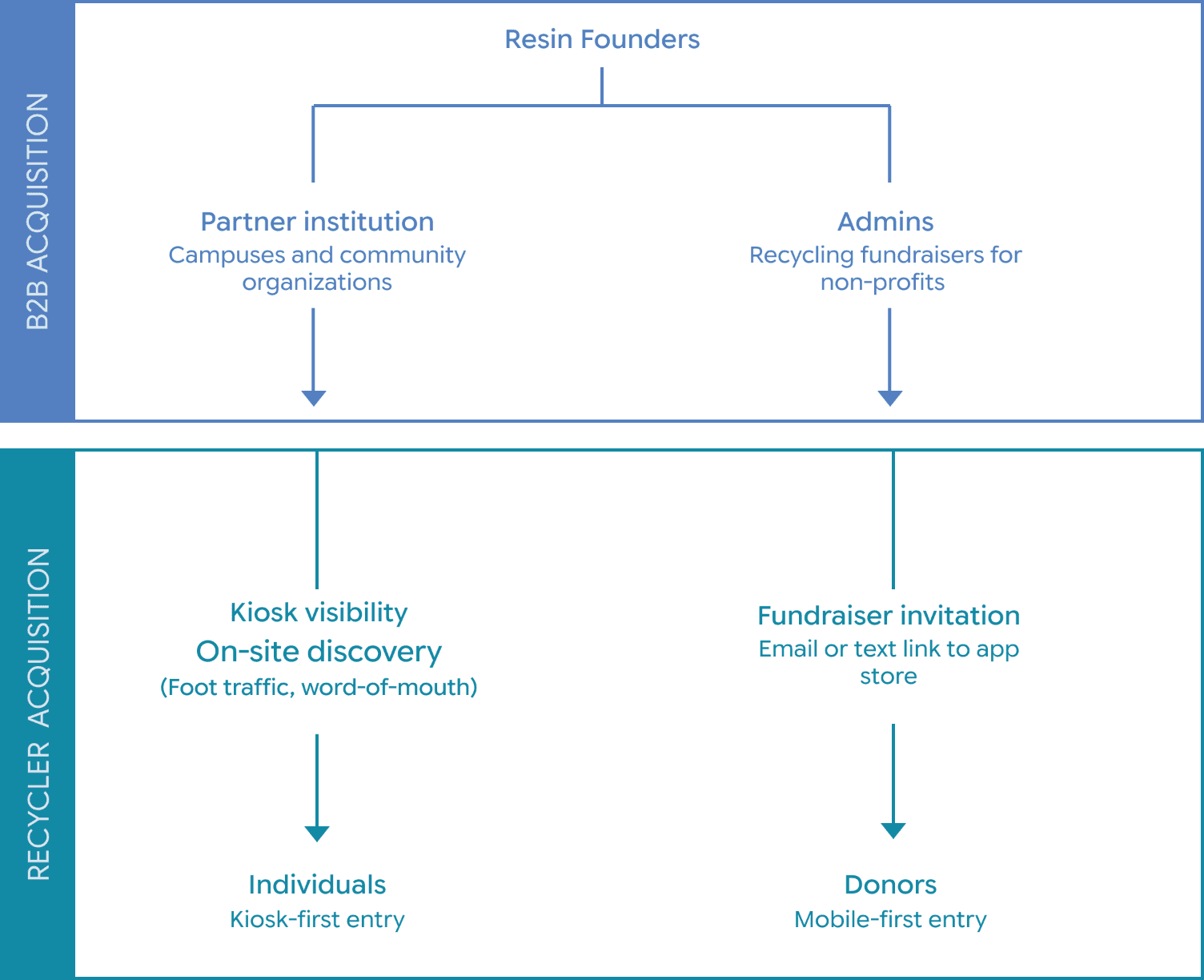
Kiosk visibility, word of mouth, and fundraiser invitations gave Resin multiple paths for acquiring recyclers.

B2C Recycling HABITS
Recycling behavior varied with context
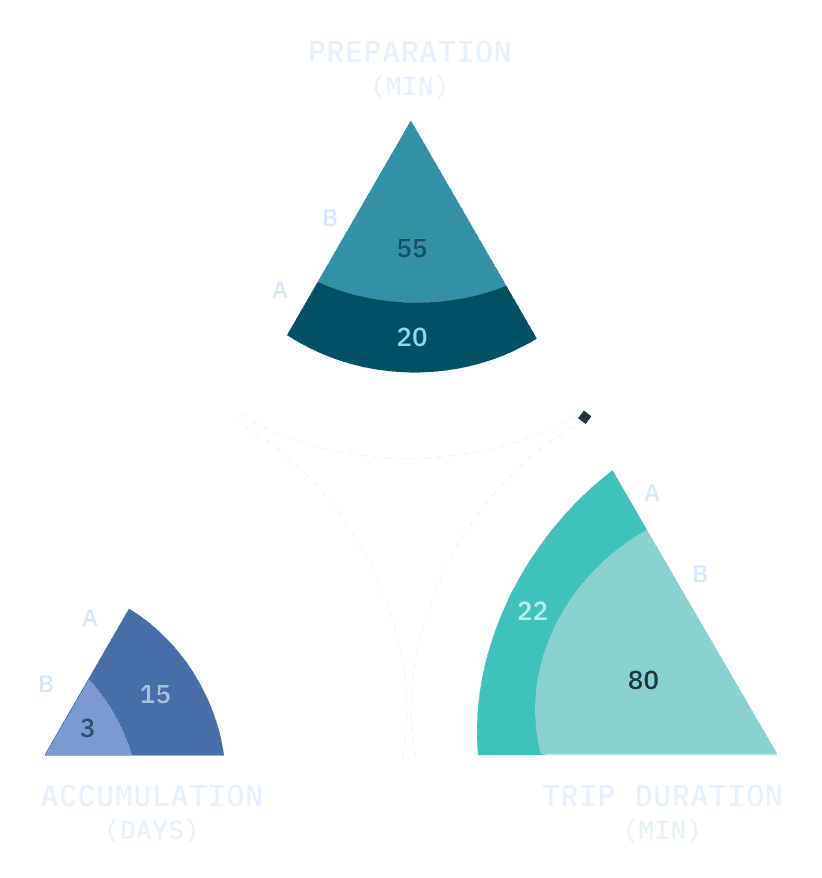
Desktop research showed that accumulation varied by predictable factors like housing density, beverage habits, and storage capacity. However, the actual effort required to recycle—and whether that effort feels worthwhile—can change from one occasion to another. Distance, opportunity, preparation, timing, and perceived reward could all shift, even for the same recycler. I used motivation as a broad signal to describe these situational changes and evaluate whether a recycling opportunity made a drop-off feel worth the effort.
BUSINESS INSIGHT
Acquisition only matters if recyclers participate
Resin’s B2C users are not just end users. Their drop-offs generate the material volume and transaction data that feed Resin’s operating model, while donor activity also advances fundraiser goals. Acquisition brings recyclers into the ecosystem; their drop-offs and repeat participation create the value.
BUSINESS INSIGHT
Acquisition only matters if recyclers participate
Resin’s B2C users are not just end users. Their drop-offs generate the material volume and transaction data that feed Resin’s operating model, while donor activity also advances fundraiser goals. Acquisition brings recyclers into the ecosystem; their drop-offs and repeat participation create the value.
B2C Recycling HABITS
Recycling behavior varied with context
Illustration: Context changes the amount of effort required for the exact same recycler. Scenario A: Effort stems from travel. Cans accumulate slowly, making preparation quick and incremental. Scenario B: Effort stems from preparation. A high-volume drop-off requires a long single session to prep, but the kiosk is a short drive away.
Desktop research showed that accumulation varied by predictable factors like housing density, beverage habits, and storage capacity. However, the actual effort required to recycle—and whether that effort feels worthwhile—can change from one occasion to another. Distance, opportunity, preparation, timing, and perceived reward could all shift, even for the same recycler. I used motivation as a broad signal to describe these situational changes and evaluate whether a recycling opportunity made a drop-off feel worth the effort.

Mobile's role in the ecosystem
Resin's mobile app doubles as infrastructure and a lever for ongoing engagement. It supports kiosk access, activation, and repeat participation, giving recyclers and admins distinct ways to drive engagement.
Behavioral hypothesis
Recycler motivation can vary from one recycling occasion to the next. If mobile provides consistent value between drop-offs—even when a recycler’s immediate network is quiet—it may make repeat participation less dependent on changing physical conditions.
Product hypothesis
If mobile gives each role a meaningful part in that loop, Resin can test whether in-app engagement supports activation, repeat drop-offs, and fundraiser progress.
Validation strategy
Each role needed a distinct test of the product hypothesis. For recyclers, the launch needed to establish activation and an initial baseline for repeat participation. For admins, it needed to define activation and a baseline for evaluating whether admin-led engagement could influence donor participation.
Scope and sequencing
Resin needed a minimum viable funnel for each role, but the launch didn’t need every capability the broader product could eventually support. I separated launch requirements from the broader design system so Resin could establish the first baselines, then expand the experience based on what it learned.
Product Strategy
BUSINESS INSIGHT
Acquisition only matters if recyclers participate
Resin’s B2C users are not just end users. Their drop-offs generate the material volume and transaction data that feed Resin’s operating model, while donor activity also advances fundraiser goals. Acquisition brings recyclers into the ecosystem; their drop-offs and repeat participation create the value.
Product Strategy
Mobile’s role in Resin’s flywheel
Resin's mobile app doubles as infrastructure and a lever for ongoing engagement. It supports kiosk access, activation, and repeat participation, giving recyclers and admins distinct ways to drive engagement.
Behavioral hypothesis
Recycler motivation can vary from one recycling occasion to the next. If mobile provides consistent value between drop-offs—even when a recycler’s immediate network is quiet—it may make repeat participation less dependent on changing physical conditions.
Product hypothesis
If mobile gives each role a meaningful part in that loop, Resin can test whether in-app engagement supports activation, repeat drop-offs, and fundraiser progress.
Validation strategy
Each role needed a distinct test of the product hypothesis. For recyclers, the launch needed to establish activation and an initial baseline for repeat participation. For admins, it needed to define activation and a baseline for evaluating whether admin-led engagement could influence donor participation.
Scope and sequencing
Resin needed a minimum viable funnel for each role to establish a baseline for engagement and growth. I separated the launch requirements from the broader design system so Resin could gather this initial data, then expand the experience based on what it learned.
Recycler
Acquisition
1st DROP OFF
Activation
Repeat
PArticipation
Early repeat-use signal
MINIMUM VIABLE FUNNEL (LAUNCH)
Referral/SHaring
Mobile-enabled
NEW RECYCLER
ACQUISITION
Mobile-enabled
RECYCLER-LED GROWTH (IDEAL FUTURE STATE)
Product Decisions
Unify the recycler experience
The original wireframes split individual and donor recycling. Because admins also needed the drop-off experience, I unified recycling across all roles while keeping fundraiser management as the primary admin path. Backend permissions let Resin phase in role-based features and rewards.
Define activation by role
The first drop-off might happen minutes, days, or weeks after downloading the app. To measure activation the pilot would need a measurable starting point for evaluating first use. I defined recycler activation as the first completed drop-off; and admin activation as launching a fundraiser.
Distinguish acquisition from early repeat use
The launch needed to show whether acquired recyclers returned after their first drop-off. I used three drop-offs as a provisional threshold because each added a different level of evidence: the first marked activation, the second a return, and the third the earliest signal of repeat behavior. I framed the progression as curiosity, intent, and early continuity, making the next drop-off the behavioral target for the launch and design system. Resin could track that threshold in 15-day increments, up to 90 days, then use follow-up research to understand why.
The minimum viable funnel gave Resin a clear path from acquisition to repeat participation—and a way to assess whether recyclers returned before investing in referral-led growth.

(L) Recycler activation is drop-off focused. (R) Admin activation centers on fundraiser creation. Donor invites we're handled outside of the app.
Install Pass
Collect recyclables
Clean recyclables
Sort recyclables
Pack/load recyclables
Travel to kiosk
Learn hardware
First drop-off
Create account
Setup fundraiser
Add payout details
Review fundraiser
Launch fundraiser
Shift to role-based engagement
The original wireframes combined growth mechanics with engagement features, but lacked a cohesive hypothesis for how they would work together to support repeat participation. That kept the app centered on the kiosk transaction, without giving recyclers much reason to re-engage between drop-offs. I shifted the product toward role-based engagement: Resin-led value for individual recyclers at launch, admin onboarding, and a path for testing admin-led donor engagement after launch.
Product Decisions
Define activation by role
The first drop-off might happen minutes, days, or weeks after downloading the app. To measure activation the pilot would need a measurable starting point for evaluating first use. I defined recycler activation as the first completed drop-off; and admin activation as launching a fundraiser.
Unify the recycler experience
Volume accumulation was a business priority for Resin, which meant that post-launch, admins would need to access to the drop off journey; and recyclers would likely need to parrticipate as individuals and donors throughout the year. The post-launch design system unified recycling across all roles while keeping fundraiser management as the primary admin path. Backend permissions let Resin phase in role-based features and rewards.
(L) Recycler activation is drop-off focused. (R) Admin activation centers on fundraiser creation. Donor invites we're handled outside of the app.
Install Pass
Collect recyclables
Clean recyclables
Sort recyclables
Pack/load recyclables
Travel to kiosk
Learn hardware
First drop-off
Create account
Setup fundraiser
Add payout details
Review fundraiser
Launch fundraiser
Distinguish acquisition from participation
The launch needed to show whether acquired recyclers returned after their first drop-off. I used three drop-offs as a provisional threshold because each added a different level of evidence: the first marked activation, the second a return, and the third the earliest signal of repeat behavior. I framed the progression as curiosity, intent, and early continuity, making the next drop-off the behavioral target for the launch and design system. Resin could track that threshold in 15-day increments, up to 90 days, then use follow-up research to understand why.
The minimum viable funnel gave Resin a clear path from acquisition to repeat participation—and a way to assess whether recyclers returned before investing in referral-led growth.

Shift to role-based engagement
The original wireframes combined growth mechanics with engagement features, but lacked a cohesive hypothesis for how they would work together to support repeat participation. I shifted the product toward role-based engagement: Resin-led value for individual recyclers at launch, admin onboarding, and a path for testing admin-led donor engagement after launch.
Product Strategy
Acquisition only matters if recyclers participate
Resin's mobile app doubles as infrastructure and a lever for ongoing engagement. It supports kiosk access, activation, and repeat participation, giving recyclers and admins distinct ways to drive engagement.
Acquisition only matters if recyclers participate
Recycler motivation can vary from one recycling occasion to the next. If mobile provides consistent value between drop-offs—even when a recycler’s immediate network is quiet—it may make repeat participation less dependent on changing physical conditions.
Acquisition only matters if recyclers participate
If mobile gives each role a meaningful part in that loop, Resin can test whether in-app engagement supports activation, repeat drop-offs, and fundraiser progress.
Acquisition only matters if recyclers participate
Each role needed a distinct test of the product hypothesis. For recyclers, the launch needed to establish activation and an initial baseline for repeat participation. For admins, it needed to define activation and a baseline for evaluating whether admin-led engagement could influence donor participation.
Acquisition only matters if recyclers participate
Resin needed a minimum viable funnel for each role, but the launch didn’t need every capability the broader product could eventually support. I separated launch requirements from the broader design system so Resin could establish the first baselines, then expand the experience based on what it learned.
The minimum viable funnel gave Resin a clear path from acquisition to repeat participation—and a way to assess whether recyclers returned before investing in referral-led growth.

BUSINESS INSIGHT
Acquisition only matters if recyclers participate
Resin’s B2C users are not just end users. Their drop-offs generate the material volume and transaction data that feed Resin’s operating model, while donor activity also advances fundraiser goals. Acquisition brings recyclers into the ecosystem; their drop-offs and repeat participation create the value.
BUSINESS INSIGHT
Acquisition only matters if recyclers participate
Resin’s B2C users are not just end users. Their drop-offs generate the material volume and transaction data that feed Resin’s operating model, while donor activity also advances fundraiser goals. Acquisition brings recyclers into the ecosystem; their drop-offs and repeat participation create the value.
Product Strategy
Behavioral hypothesis
Recycler motivation can vary from one recycling occasion to the next. If mobile provides consistent value between drop-offs—even when a recycler’s immediate network is quiet—it may make repeat participation less dependent on changing physical conditions.
Acquisition only matters if recyclers participate
Resin’s B2C users are not just end users. Their drop-offs generate the material volume and transaction data that feed Resin’s operating model, while donor activity also advances fundraiser goals. Acquisition brings recyclers into the ecosystem; their drop-offs and repeat participation create the value.
Acquisition only matters if recyclers participate
Resin’s B2C users are not just end users. Their drop-offs generate the material volume and transaction data that feed Resin’s operating model, while donor activity also advances fundraiser goals. Acquisition brings recyclers into the ecosystem; their drop-offs and repeat participation create the value.
Acquisition only matters if recyclers participate
Resin’s B2C users are not just end users. Their drop-offs generate the material volume and transaction data that feed Resin’s operating model, while donor activity also advances fundraiser goals. Acquisition brings recyclers into the ecosystem; their drop-offs and repeat participation create the value.
Acquisition only matters if recyclers participate
Resin’s B2C users are not just end users. Their drop-offs generate the material volume and transaction data that feed Resin’s operating model, while donor activity also advances fundraiser goals. Acquisition brings recyclers into the ecosystem; their drop-offs and repeat participation create the value.
Acquisition only matters if recyclers participate
Resin’s B2C users are not just end users. Their drop-offs generate the material volume and transaction data that feed Resin’s operating model, while donor activity also advances fundraiser goals. Acquisition brings recyclers into the ecosystem; their drop-offs and repeat participation create the value.
Product Strategy
Mobile’s role in Resin’s flywheel
Resin's mobile app doubles as infrastructure and a lever for ongoing engagement. It supports kiosk access, activation, and repeat participation, giving recyclers and admins distinct ways to drive engagement.
Behavioral hypothesis
Recycler motivation can vary from one recycling occasion to the next. If mobile provides consistent value between drop-offs—even when a recycler’s immediate network is quiet—it may make repeat participation less dependent on changing physical conditions.
Product hypothesis
If mobile gives each role a meaningful part in that loop, Resin can test whether in-app engagement supports activation, repeat drop-offs, and fundraiser progress.
Validation strategy
Each role needed a distinct test of the product hypothesis. For recyclers, the launch needed to establish activation and an initial baseline for repeat participation. For admins, it needed to define activation and a baseline for evaluating whether admin-led engagement could influence donor participation.
Scope and sequencing
Resin needed a minimum viable funnel for each role to establish a baseline for engagement and growth. I separated the launch requirements from the broader design system so Resin could gather this initial data, then expand the experience based on what it learned.
The minimum viable funnel gave Resin a clear path from acquisition to repeat participation—and a way to assess whether recyclers returned before investing in referral-led growth.
Product Decisions
BUSINESS INSIGHT
Acquisition only matters if recyclers participate
Resin’s B2C users are not just end users. Their drop-offs generate the material volume and transaction data that feed Resin’s operating model, while donor activity also advances fundraiser goals. Acquisition brings recyclers into the ecosystem; their drop-offs and repeat participation create the value.
BUSINESS INSIGHT
Acquisition only matters if recyclers participate
Resin’s B2C users are not just end users. Their drop-offs generate the material volume and transaction data that feed Resin’s operating model, while donor activity also advances fundraiser goals. Acquisition brings recyclers into the ecosystem; their drop-offs and repeat participation create the value.
BUSINESS INSIGHT
Acquisition only matters if recyclers participate
Resin’s B2C users are not just end users. Their drop-offs generate the material volume and transaction data that feed Resin’s operating model, while donor activity also advances fundraiser goals. Acquisition brings recyclers into the ecosystem; their drop-offs and repeat participation create the value.
BUSINESS INSIGHT
Acquisition only matters if recyclers participate
Resin’s B2C users are not just end users. Their drop-offs generate the material volume and transaction data that feed Resin’s operating model, while donor activity also advances fundraiser goals. Acquisition brings recyclers into the ecosystem; their drop-offs and repeat participation create the value.
Execution
Design focused on translating the minimum viable funnel into a technically feasible foundation. I mapped the core behaviors into reusable components, leveraged existing code libraries to protect engineering bandwidth, and prioritized accessibility over heavy brand expression.
Product Decisions
Unify the recycler experience
The original wireframes split individual and donor recycling. Because admins also needed the drop-off experience, I unified recycling across all roles while keeping fundraiser management as the primary admin path. Backend permissions let Resin phase in role-based features and rewards.
Define activation by role
The first drop-off might happen minutes, days, or weeks after downloading the app. To measure activation the pilot would need a measurable starting point for evaluating first use. I defined recycler activation as the first completed drop-off; and admin activation as launching a fundraiser.
Distinguish acquisition from early repeat use
The launch needed to show whether acquired recyclers returned after their first drop-off. I used three drop-offs as a provisional threshold because each added a different level of evidence: the first marked activation, the second a return, and the third the earliest signal of repeat behavior. I framed the progression as curiosity, intent, and early continuity, making the next drop-off the behavioral target for the launch and design system. Resin could track that threshold in 15-day increments, up to 90 days, then use follow-up research to understand why.
(L) Recycler activation is drop-off focused. (R) Admin activation centers on fundraiser creation. Donor invites we're handled outside of the app.
Install Pass
Collect recyclables
Clean recyclables
Sort recyclables
Pack/load recyclables
Travel to kiosk
Learn hardware
First drop-off
Create account
Setup fundraiser
Add payout details
Review fundraiser
Launch fundraiser
Shift to role-based engagement
The original wireframes combined growth mechanics with engagement features, but lacked a cohesive hypothesis for how they would work together to support repeat participation. That kept the app centered on the kiosk transaction, without giving recyclers much reason to re-engage between drop-offs. I shifted the product toward role-based engagement: Resin-led value for individual recyclers at launch, admin onboarding, and a path for testing admin-led donor engagement after launch.
The minimum viable funnel gave Resin a clear path from acquisition to repeat participation—and a way to assess whether recyclers returned before investing in referral-led growth.
A retail-inspired approach to autonomous recycling
Institutional hosting became Resin’s physical distribution strategy. Partners placed branded kiosks in high-traffic settings, giving Resin physical distribution, on-site marketing, and transaction data that fed its recycling operations.
distribution
Discovery
How mobile scaled Resin's recycling ecosystem
How mobile scaled Resin's recycling ecosystem
Overview
Resin is a pre-seed climate-tech company modernizing aluminum recycling through autonomous, IoT-enabled kiosks and a mobile app. Recyclers track drop-offs and direct rewards toward personal or fundraiser goals, while admins set up and manage fundraisers. Institutional partners host the service, and Resin oversees the technology and operations behind it.
Resin acquired recyclers through kiosk visibility, word of mouth, and fundraiser invitations, but the mobile launch was organized primarily around the kiosk transaction. The unresolved question was what happened after acquisition: the mobile launch lacked a clear funnel hypothesis for turning that demand into completed drop-offs and repeat participation. Without that baseline, the app's referral-led growth could stall and create a leaky funnel.
ECOSYSTEM ROLES
Resin designed its B2B2C business model around the ecosystem needed to support its mission—and create the conditions for a flywheel.
Role
Persona/Type
Contribution
Outcome
Recycler
Indvidual or donor
Completes drop-offs, moves aluminum into Resin’s system, and generates participation data. Donors direct earnings toward a fundraiser.
Value creation: participation, recycling data, and material flow
Admin
Nonprofit organizer
Creates and manages fundraisers, brings participants into Resin, and supports donor participation. Can also recycle.
Acquisition and engagement
Institutional host
Campus or community organization
Provides kiosk placement, physical distribution, on-site visibility, and access to an existing community.
Distribution and community access
Recycling operations
Resin kiosk operations and downstream recycling partners
Services stations and moves collected aluminum through pickup, processing, and downstream recycling.
Operations, data, and material recovery
ACQUISITION
Kiosk visibility, word of mouth, and fundraiser invitations gave Resin multiple paths for acquiring recyclers.
BUSINESS INSIGHT
Acquisition only matters if recyclers participate
Getting recyclers into the ecosystem was only the first step. Each drop-off added material volume and transaction data to Resin’s operating model; donor drop-offs also contributed to fundraiser goals. The more consistently recyclers returned, the more value that acquisition could generate.
BUSINESS INSIGHT
Acquisition only matters if recyclers participate
The first drop-off might happen minutes, days, or weeks after downloading the app. To measure activation the pilot would need a measurable starting point for evaluating first use. I defined recycler activation as the first completed drop-off; and admin activation as launching a fundraiser.
BUSINESS INSIGHT
Acquisition only matters if recyclers participate
The first drop-off might happen minutes, days, or weeks after downloading the app. To measure activation the pilot would need a measurable starting point for evaluating first use. I defined recycler activation as the first completed drop-off; and admin activation as launching a fundraiser.
BUSINESS INSIGHT
Acquisition only matters if recyclers participate
The first drop-off might happen minutes, days, or weeks after downloading the app. To measure activation the pilot would need a measurable starting point for evaluating first use. I defined recycler activation as the first completed drop-off; and admin activation as launching a fundraiser.
Product Decisions
Unify the recycler experience
Volume accumulation was a business priority for Resin, which meant that post-launch, admins would need to access to the drop off journey; and recyclers would likely need to parrticipate as individuals and donors throughout the year. The post-launch design system unified recycling across all roles while keeping fundraiser management as the primary admin path. Backend permissions let Resin phase in role-based features and rewards.
Define activation by role
The first drop-off might happen minutes, days, or weeks after downloading the app. To measure activation the pilot would need a measurable starting point for evaluating first use. I defined recycler activation as the first completed drop-off; and admin activation as launching a fundraiser.
(Top) Recycler activation is drop-off focused. (Bottom) Admin activation centers on fundraiser creation. Donor invites we're handled outside of the app.
Install Pass
Collect recyclables
Clean recyclables
Sort recyclables
Pack/load recyclables
Travel to kiosk
Learn hardware
First drop-off
Create account
Setup fundraiser
Add payout details
Review fundraiser
Launch fundraiser
Distinguish acquisition from participation
The launch needed to show whether acquired recyclers returned after their first drop-off. I used three drop-offs as a provisional threshold because each added a different level of evidence: the first marked activation, the second a return, and the third the earliest signal of repeat behavior. I framed the progression as curiosity, intent, and early continuity, making the next drop-off the behavioral target for the launch and design system. Resin could track that threshold in 15-day increments, up to 90 days, then use follow-up research to understand why.
The minimum viable funnel gave Resin a clear path from acquisition to repeat participation—and a way to assess whether recyclers returned before investing in referral-led growth.
Shift to role-based engagement
The original wireframes combined growth mechanics with engagement features, but lacked a cohesive hypothesis for how they would work together to support repeat participation. I shifted the product toward role-based engagement: Resin-led value for individual recyclers at launch, admin onboarding, and a path for testing admin-led donor engagement after launch.
Phase
Engagement Lever
Product Goal
V1 (Launch)
Automated milestone emails; basic scalar progress widgets in-app.
Establish the initial baseline for repeat donor drop-offs at 15- to 90-day intervals.
Next Step (TBD): Qualitative Research
Conduct admin and recycler interviews based on V1 behavior.
Understand if the V1 data actually motivates admins, and how they already communicate with their communities off-app.
Next Step (TBD): Concierge Testing
Founders manually facilitate admin updates or test manual SMS nudges.
Test if personalized admin context actually drives donor retention before writing any code to build a messaging UI.
Future Iterations (Scale)
In-app reporting widgets tracking Month-over-Month progress, Pending Referrals, and New Donors.
Shift the product focus from establishing baseline retention to scaling the referral and acquisition loop.
Product Decisions
Unify the recycler experience
Volume accumulation was a business priority for Resin, which meant that post-launch, admins would need to access to the drop off journey; and recyclers would likely need to parrticipate as individuals and donors throughout the year. The post-launch design system unified recycling across all roles while keeping fundraiser management as the primary admin path. Backend permissions let Resin phase in role-based features and rewards.
Define activation by role
The first drop-off might happen minutes, days, or weeks after downloading the app. To measure activation the pilot would need a measurable starting point for evaluating first use. I defined recycler activation as the first drop-off; and admin activation as launching a fundraiser.
(Top) Recycler activation is drop-off focused. (Bottom) Admin activation centers on fundraiser creation. Donor invites we're handled outside of the app.
The minimum viable funnel gave Resin a clear path from acquisition to repeat participation—and a way to assess whether recyclers returned before investing in referral-led growth.
Shift to role-based engagement
The original wireframes combined growth mechanics with engagement features, but lacked a cohesive hypothesis for how they would work together to support repeat participation. I shifted the product toward role-based engagement: Resin-led value for individual recyclers at launch, admin onboarding, and a path for testing admin-led donor engagement after launch.
Distinguish acquisition from participation
The launch needed to show whether acquired recyclers returned after their first drop-off. I used three drop-offs as a provisional threshold because each added a different level of evidence: the first marked activation, the second a return, and the third the earliest signal of repeat behavior. I framed the progression as curiosity, intent, and early continuity, making the next drop-off the behavioral target for the launch and design system. Resin could track that threshold in 15-day increments, up to 90 days, then use follow-up research to understand why.

Phase
Engagement Lever
Product Goal
V1 (Launch)
Automated milestone emails; basic scalar progress widgets in-app.
Establish the initial baseline for repeat donor drop-offs at 15- to 90-day intervals.
Next Step (TBD): Qualitative Research
Conduct admin and recycler interviews based on V1 behavior.
Understand if the V1 data actually motivates admins, and how they already communicate with their communities off-app.
Next Step (TBD): Concierge Testing
Founders manually facilitate admin updates or test manual SMS nudges.
Test if personalized admin context actually drives donor retention before writing any code to build a messaging UI.
Future Iterations (Scale)
In-app reporting widgets tracking Month-over-Month progress, Pending Referrals, and New Donors.
Shift the product focus from establishing baseline retention to scaling the referral and acquisition loop.
Product Decisions
Acquisition only matters if recyclers participate
The original wireframes split individual and donor recycling. Because admins also needed the drop-off experience, I unified recycling across all roles while keeping fundraiser management as the primary admin path. Backend permissions let Resin phase in role-based features and rewards.
Acquisition only matters if recyclers participate
The first drop-off might happen minutes, days, or weeks after downloading the app. To measure activation the pilot would need a measurable starting point for evaluating first use. I defined recycler activation as the first completed drop-off; and admin activation as launching a fundraiser.
Acquisition only matters if recyclers participate
To distinguish one-time participation from emerging repeat use, I set the third drop-off as the provisional threshold. Tracking repeat drop-offs in 15-day increments (up to 90 days) established an early repeat-use pattern. The first drop-off was activation; the second showed intent ; the third strengthened the early repeat-use signal.

Acquisition only matters if recyclers participate
The original experience relied on cold-start leaderboards, invite-only competitions, and gated incentives, and did little to encourage participation beyond the kiosk. I introduced Resin-led engagement for individual recyclers, onboarding for admins, and post-launch tools to help admins engage donors more effectively.
Phase
Engagement Lever
Product Goal
V1 (Launch)
Automated milestone emails; basic scalar progress widgets in-app.
Establish the initial baseline for repeat donor drop-offs at 15- to 90-day intervals.
Next Step (TBD): Qualitative Research
Conduct admin and recycler interviews based on V1 behavior.
Understand if the V1 data actually motivates admins, and how they already communicate with their communities off-app.
Next Step (TBD): Concierge Testing
Founders manually facilitate admin updates or test manual SMS nudges.
Test if personalized admin context actually drives donor retention before writing any code to build a messaging UI.
Future Iterations (Scale)
In-app reporting widgets tracking Month-over-Month progress, Pending Referrals, and New Donors.
Shift the product focus from establishing baseline retention to scaling the referral and acquisition loop.
BEHAVIORAL RESEARCH
Recycling behavior varied with context
Desktop research showed that accumulation varied by predictable factors like housing density, beverage habits, and storage capacity. However, the actual effort required to recycle—and whether that effort feels worthwhile—can change from one occasion to another. Distance, opportunity, preparation, timing, and perceived reward could all shift, even for the same recycler. I used motivation as a broad signal for whether recycling felt worth the effort in a given situation.
Illustration: Context changes the amount of effort required for the exact same recycler. Scenario A: Effort stems from travel. Cans accumulate slowly, making preparation quick and incremental. Scenario B: Effort stems from preparation. A high-volume drop-off requires a long single session to prep, but the kiosk is a short drive away.

Product Strategy
Mobile's role in the ecosystem
Resin's mobile app doubles as infrastructure and a lever for ongoing engagement. It supports kiosk access, activation, and repeat participation, giving recyclers and admins distinct ways to drive engagement.
Behavioral hypothesis
Recycler motivation can vary from one recycling occasion to the next. If mobile provides consistent value between drop-offs—even when a recycler’s immediate network is quiet—it may make repeat participation less dependent on changing physical conditions.
Product hypothesis
If mobile gives each role a meaningful part in that loop, Resin can test whether in-app engagement supports activation, repeat drop-offs, and fundraiser progress.
Validation strategy
Each role needed a distinct test of the product hypothesis. For recyclers, the launch needed to establish activation and an initial baseline for repeat participation. For admins, it needed to define activation and a baseline for evaluating whether admin-led engagement could influence donor participation.
Scope and sequencing
Resin needed a minimum viable funnel for each role, but the launch didn’t need every capability the broader product could eventually support. I separated launch requirements from the broader design system so Resin could establish the first baselines, then expand the experience based on what it learned.
Product Decisions
Unify the recycler experience
The original wireframes split individual and donor recycling. Because admins also needed the drop-off experience, I unified recycling across all roles while keeping fundraiser management as the primary admin path. Backend permissions let Resin phase in role-based features and rewards.
Define activation by role
The first drop-off might happen minutes, days, or weeks after downloading the app. To measure activation the pilot would need a measurable starting point for evaluating first use. I defined recycler activation as the first completed drop-off; and admin activation as launching a fundraiser.
Distinguish acquisition from early repeat use
The launch needed to show whether acquired recyclers returned after their first drop-off. I used three drop-offs as a provisional threshold because each added a different level of evidence: the first marked activation, the second a return, and the third the earliest signal of repeat behavior. I framed the progression as curiosity, intent, and early continuity, making the next drop-off the behavioral target for the launch and design system. Resin could track that threshold in 15-day increments, up to 90 days, then use follow-up research to understand why.
The minimum viable funnel gave Resin a clear path from acquisition to repeat participation—and a way to assess whether recyclers returned before investing in referral-led growth.

Shift to role-based engagement
The original wireframes combined growth mechanics with engagement features, but lacked a cohesive hypothesis for how they would work together to support repeat participation. I shifted the product toward role-based engagement: Resin-led value for individual recyclers at launch, admin onboarding, and a path for testing admin-led donor engagement after launch.
(Top) Recycler activation is drop-off focused. (Bottom) Admin activation centers on fundraiser creation.
Phase
Engagement Lever
Product Goal
V1 (Launch)
Automated milestone emails; basic scalar progress widgets in-app.
Establish the initial baseline for repeat donor drop-offs at 15- to 90-day intervals.
Next Step (TBD): Qualitative Research
Conduct admin and recycler interviews based on V1 behavior.
Understand if the V1 data actually motivates admins, and how they already communicate with their communities off-app.
Next Step (TBD): Concierge Testing
Founders manually facilitate admin updates or test manual SMS nudges.
Test if personalized admin context actually drives donor retention before writing any code to build a messaging UI.
Future Iterations (Scale)
In-app reporting widgets tracking Month-over-Month progress, Pending Referrals, and New Donors.
Shift the product focus from establishing baseline retention to scaling the referral and acquisition loop.
Acquisition only matters if recyclers participate
The first drop-off might happen minutes, days, or weeks after downloading the app. To measure activation the pilot would need a measurable starting point for evaluating first use. I defined recycler activation as the first completed drop-off; and admin activation as launching a fundraiser.
Acquisition only matters if recyclers participate
To distinguish one-time participation from emerging repeat use, I set the third drop-off as the provisional threshold. Tracking repeat drop-offs in 15-day increments (up to 90 days) established an early repeat-use pattern. The first drop-off was activation; the second showed intent ; the third strengthened the early repeat-use signal.
Acquisition only matters if recyclers participate
The original experience relied on cold-start leaderboards, invite-only competitions, and gated incentives, and did little to encourage participation beyond the kiosk. I introduced Resin-led engagement for individual recyclers, onboarding for admins, and post-launch tools to help admins engage donors more effectively.
Acquisition only matters if recyclers participate
The original wireframes split individual and donor recycling. Because admins also needed the drop-off experience, I unified recycling across all roles while keeping fundraiser management as the primary admin path. Backend permissions let Resin phase in role-based features and rewards.
A retail-inspired approach to autonomous recycling
Institutional hosting became Resin’s physical distribution strategy. Partners placed branded kiosks in high-traffic settings, giving Resin physical distribution, on-site marketing, and transaction data that fed its recycling operations.
distribution
Discovery
Execution
Design focused on translating the minimum viable funnel into a technically feasible foundation. I mapped the core behaviors into reusable components, leveraged existing code libraries to protect engineering bandwidth, and prioritized accessibility over heavy brand expression.


Discovery
DISTRIBUTION
A retail-inspired approach to autonomous recycling
Institutional hosting became Resin’s physical distribution strategy. Partners placed branded kiosks in high-traffic settings, giving Resin physical distribution, on-site marketing, and transaction data that fed its recycling operations.
ECOSYSTEM ROLES
Resin designed its B2B2C business model around the ecosystem needed to support its mission—and create the conditions for a flywheel.
Role
Persona/Type
Contribution
Outcome
Recycler
Indvidual or donor
Completes drop-offs, moves aluminum into Resin’s system, and generates participation data. Donors direct earnings toward a fundraiser.
Value creation: participation, recycling data, and material flow
Admin
Nonprofit organizer
Creates and manages fundraisers, brings participants into Resin, and supports donor participation. Can also recycle.
Acquisition and engagement
Institutional Partner
Campus or community organization
Provides kiosk placement, physical distribution, on-site visibility, and access to an existing community.
Distribution and community access
Recycling operations
Resin kiosk operations and downstream recycling partners
Services stations and moves collected aluminum through pickup, processing, and downstream recycling.
Operations, data, and material recovery
ACQUISITION
Kiosk visibility, word of mouth, and fundraiser invitations gave Resin multiple paths for acquiring recyclers.
VALUE CREATION
Acquisition only matters if recyclers participate
Getting recyclers into the ecosystem was only the first step. Each drop-off added material volume and transaction data to Resin’s operating model; donor drop-offs also contributed to fundraiser goals. The more consistently recyclers returned, the more value that acquisition could generate.
BEHAVIORAL RESEARCH
Recycling behavior varied with context
Desktop research showed that accumulation varied by predictable factors like housing density, beverage habits, and storage capacity. However, the actual effort required to recycle—and whether that effort feels worthwhile—can change from one occasion to another. Distance, opportunity, preparation, timing, and perceived reward could all shift, even for the same recycler. I used motivation as a broad signal for whether recycling felt worth the effort in a given situation.
Illustration: Context changes the amount of effort required for the exact same recycler. Scenario A: Effort stems from travel. Cans accumulate slowly, making preparation quick and incremental. Scenario B: Effort stems from preparation. A high-volume drop-off requires a long single session to prep, but the kiosk is a short drive away.
Product Strategy
Mobile's role in the ecosystem
Resin's mobile app doubles as infrastructure and a lever for ongoing engagement. It supports kiosk access, activation, and repeat participation, giving recyclers and admins distinct ways to drive engagement.
Behavioral hypothesis
Recycler motivation can vary from one recycling occasion to the next. If mobile provides consistent value between drop-offs—even when a recycler’s immediate network is quiet—it may make repeat participation less dependent on changing physical conditions.
Product hypothesis
If mobile gives each role a meaningful part in that loop, Resin can test whether in-app engagement supports activation, repeat drop-offs, and fundraiser progress.
Validation strategy
Each role needed a distinct test of the product hypothesis. For recyclers, the launch needed to establish activation and an initial baseline for repeat participation. For admins, it needed to define activation and a baseline for evaluating whether admin-led engagement could influence donor participation.
Scope and sequencing
Resin needed a minimum viable funnel for each role, but the launch didn’t need every capability the broader product could eventually support. I separated launch requirements from the broader design system so Resin could establish the first baselines, then expand the experience based on what it learned.
Product Decisions
Unify the recycler experience
Volume accumulation was a business priority for Resin, which meant that post-launch, admins would need to access to the drop off journey; and recyclers would likely need to parrticipate as individuals and donors throughout the year. The post-launch design system unified recycling across all roles while keeping fundraiser management as the primary admin path. Backend permissions let Resin phase in role-based features and rewards.
Define activation by role
The first drop-off might happen minutes, days, or weeks after downloading the app. To measure activation the pilot would need a measurable starting point for evaluating first use. I defined recycler activation as the first completed drop-off; and admin activation as launching a fundraiser.
(Top) Recycler activation is drop-off focused. (Bottom) Admin activation centers on fundraiser creation. Donor invites we're handled outside of the app.
Install Pass
Collect recyclables
Clean recyclables
Sort recyclables
Pack/load recyclables
Travel to kiosk
Learn hardware
First drop-off
Create account
Setup fundraiser
Add payout details
Review fundraiser
Launch fundraiser
Distinguish acquisition from participation
The launch needed to show whether acquired recyclers returned after their first drop-off. I used three drop-offs as a provisional threshold because each added a different level of evidence: the first marked activation, the second a return, and the third the earliest signal of repeat behavior. I framed the progression as curiosity, intent, and early continuity, making the next drop-off the behavioral target for the launch and design system. Resin could track that threshold in 15-day increments, up to 90 days, then use follow-up research to understand why.
The minimum viable funnel gave Resin a clear path from acquisition to repeat participation—and a way to assess whether recyclers returned before investing in referral-led growth.
Shift to role-based engagement
The original wireframes combined growth mechanics with engagement features, but lacked a cohesive hypothesis for how they would work together to support repeat participation. I shifted the product toward role-based engagement: Resin-led value for individual recyclers at launch, admin onboarding, and a path for testing admin-led donor engagement after launch.
Phase
Engagement Lever
Product Goal
V1 (Launch)
Automated milestone emails; basic scalar progress widgets in-app.
Establish the initial baseline for repeat donor drop-offs at 15- to 90-day intervals.
Next Step (TBD): Qualitative Research
Conduct admin and recycler interviews based on V1 behavior.
Understand if the V1 data actually motivates admins, and how they already communicate with their communities off-app.
Next Step (TBD): Concierge Testing
Founders manually facilitate admin updates or test manual SMS nudges.
Test if personalized admin context actually drives donor retention before writing any code to build a messaging UI.
Future Iterations (Scale)
In-app reporting widgets tracking Month-over-Month progress, Pending Referrals, and New Donors.
Shift the product focus from establishing baseline retention to scaling the referral and acquisition loop.
Execution
Design focused on translating the minimum viable funnel into a technically feasible foundation. I mapped the core behaviors into reusable components, leveraged existing code libraries to protect engineering bandwidth, and prioritized accessibility over heavy brand expression.
Post-Launch
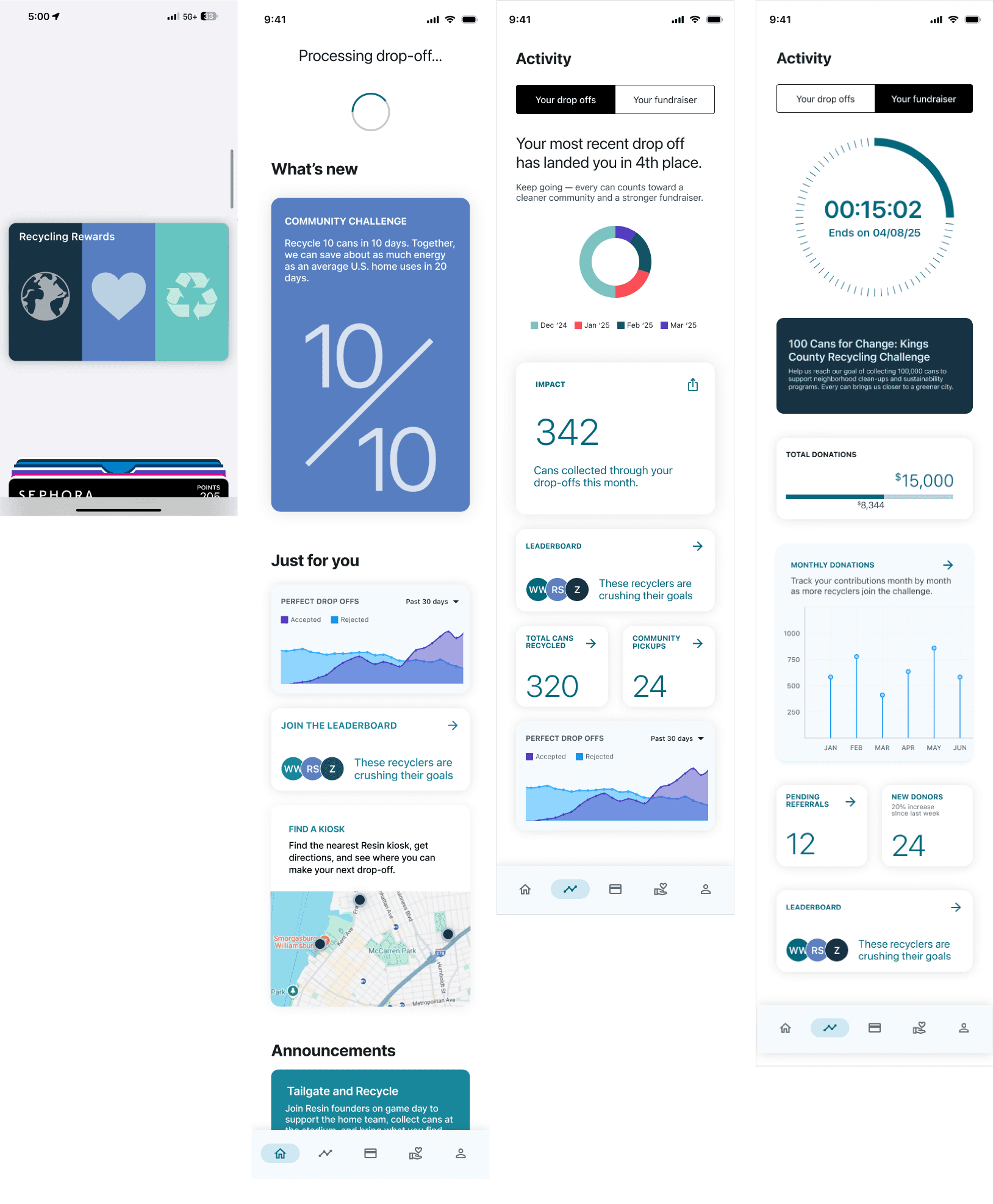
By launching a minimum viable funnel, Resin avoided building features for an unproven process. The initial release focused on a clear behavioral test: tracking if recyclers made a third drop-off within 15-day increments (up to 90 days). This baseline defines the mobile app's role. Once the data establishes a reliable retention rate, Resin will have a safe foundation to expand into new features like sharing and referral mechanics, in-app community features, and detailed admin reporting widgets.
Post-Launch
By launching a minimum viable funnel, Resin avoided building features for an unproven process. The initial release focused on a clear behavioral test: tracking if recyclers made a third drop-off within 15-day increments (up to 90 days). This baseline defines the mobile app's role. Once the data establishes a reliable retention rate, Resin will have a safe foundation to expand into new features like sharing and referral mechanics, in-app community features, and detailed admin reporting widgets.
Post-Launch
By launching a minimum viable funnel, Resin avoided building features for an unproven process. The initial release focused on a clear behavioral test: tracking if recyclers made a third drop-off within 15-day increments (up to 90 days). This baseline defines the mobile app's role. Once the data establishes a reliable retention rate, Resin will have a safe foundation to expand into new features like sharing and referral mechanics, in-app community features, and detailed admin reporting widgets.